
InGen · For investment teams
Screen, diligence and decide, with every finding linked to its source.
InGen supports investment teams from the first look at a target to the committee paper. It reads what an associate would read, records what it finds with the evidence attached, and leaves the judgement to you.
What InGen does
Four jobs, one record of evidence.

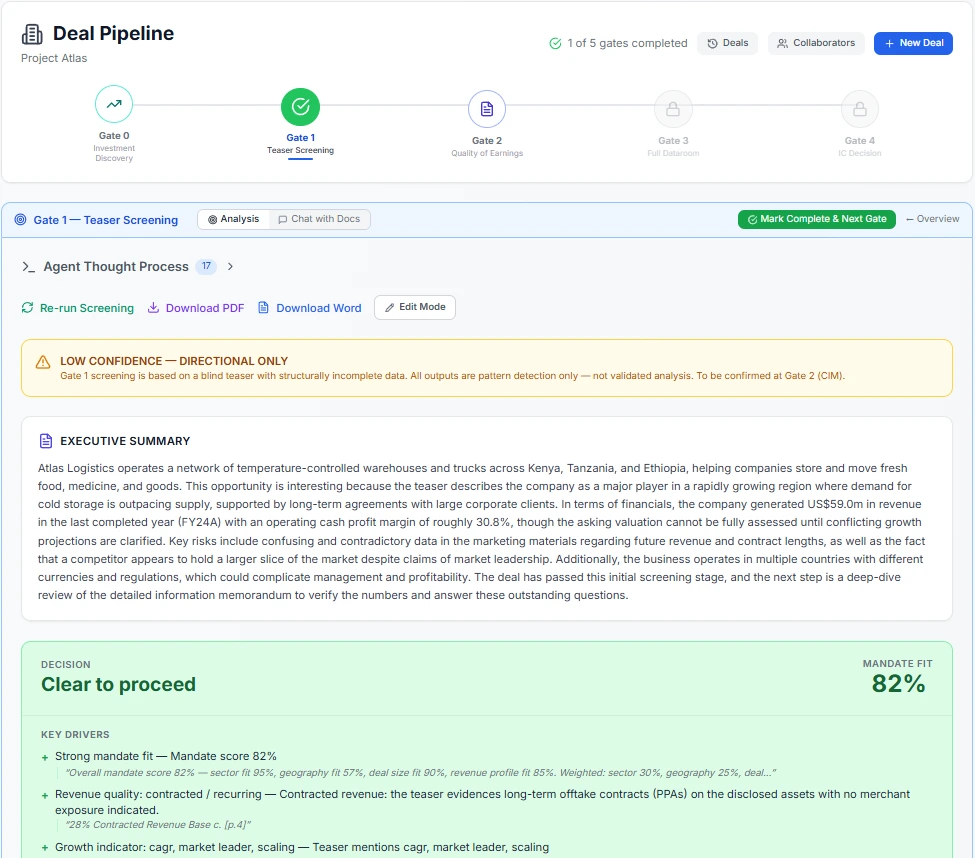
Every deal moves through five gates. A gate unlocks only when a person marks the one before it complete.
Investment screening
Search for and assess targets against your mandate: sector, size, growth, ownership. InGen gives a consistent first view of each company and its competitors, so the team spends its time on the ones worth pursuing.Financial analysis
InGen reads management accounts, models and schedules, rebuilds the key measures, benchmarks them against peers and flags where management’s numbers and the underlying documents disagree.Risk assessment
It works through the commercial, financial, legal and operational material in a data room and records each risk as a finding, with the evidence attached and the severity proposed for an analyst to confirm.Decision support
Screening notes, diligence summaries and committee material are assembled from reviewed findings, so the paper and the evidence behind it stay connected.
Inside InGen
What the team actually receives.
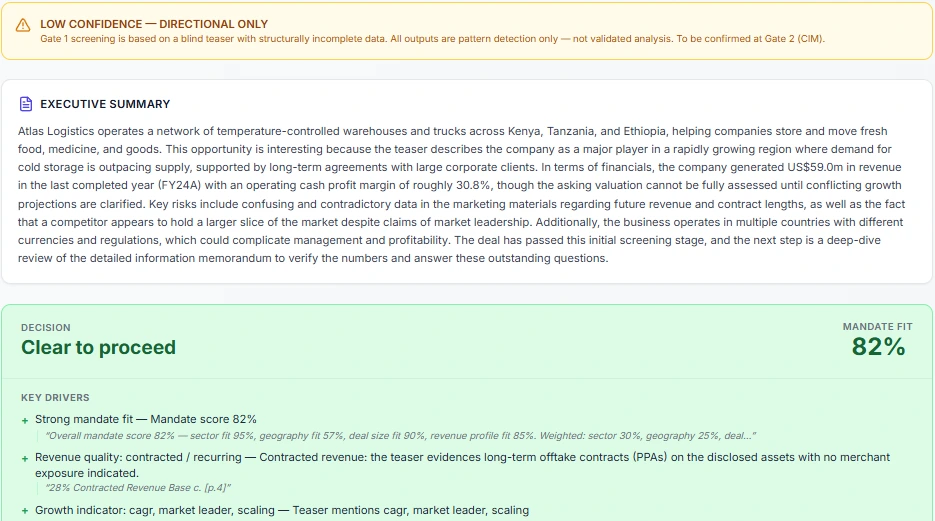
A real screening report from InGen, shown with demonstration data.
What to look at
- 1A warning when the evidence is thin. Here InGen says the result is directional only, because it has seen just a blind teaser.
- 2A summary anyone on the team can read, with the numbers and the open questions.
- 3A decision with a mandate-fit score, and the drivers behind it quoting the page they came from.
Further along the pipeline
Illustrations of what the later gates produce: a first pass at quality of earnings, and a risk recorded with the documents behind it.
Are the profits as good as they look?
| Measure | FY22 | FY23 | FY24 |
|---|---|---|---|
| Revenue (£m) | 38.8 | 43.4 | 48.2 |
| Gross margin | 31.2% | 30.4% | 29.1% |
| Reported EBITDA (£m) | 5.4 | 5.9 | 6.2 |
| Adjustments added back (£m) | 0.3 | 0.5 | 0.9 |
| Adjusted EBITDA (£m) | 5.7 | 6.4 | 7.1 |
| Adjusted margin | 14.7% | 14.7% | 14.7% |
What InGen noticed. The margin only looks steady because the adjustments have tripled while gross margin fell.source 3 Two of the five adjustments (£0.4m) have no supporting document.source 4
Financial analysis. InGen rebuilds the measures from the accounts, then says what it noticed: here, that a flat adjusted margin depends on add-backs the data room does not support.
Too much revenue from too few customers
The ten largest customers bring in 46% of revenue.source 1 The largest, a grocery retailer, brings in 14% and can end its contract with six months’ notice.source 2
Where this comes from
- 1.Customer revenue spreadsheet, FY22–FY24Data room 4.2.1 · sheet “By customer”, rows 4–13 · calculated, workings saved
- 2.Contract with Customer AData room 4.3.7 · page 12, clause 18.2 · quoted from the document
Checked by an analyst against the documents
Waiting for partner sign-off
A finding linked to its source. The claim, the two documents it rests on, how each figure was obtained, and who has reviewed it so far.
Who it is for
Built for teams that invest in private companies.
- Private equity
- Screen more of the market with the same team, and arrive at exclusivity with the risks already mapped.
- Venture capital
- Compare companies and their competitors consistently, even when the documentation is thin.
- Family offices and angel investors
- Bring institutional discipline to direct deals without an institutional-sized team.
- Corporate M&A
- Assess targets against strategic fit as well as financial return, with a record the board can examine.
Questions investment teams ask
Before you book a demonstration.
- Where do the findings come from?
- From the documents and data you provide, such as a data room, and from public sources you approve. Each finding cites the specific document and location. Where InGen cannot find support for a claim, it says so rather than filling the gap.
- How do we know the numbers are right?
- Every calculation keeps its inputs and workings, so an analyst can check it quickly. InGen labels what is an extracted fact, what is a calculation and what is a judgement. It is designed to be checked, not taken on trust.
- Who can see our deal information?
- Access is restricted by deal and logged. Where InGen runs and where documents are held are agreed with you before anything is uploaded. The governance page explains the options.
- Does it replace the deal team or our advisers?
- No. InGen does the reading, extraction and first-pass analysis. Judgement and the decision stay with the team, and it does not replace specialist legal, tax or commercial advice. It helps the team reach those conversations better prepared.
- What happens after the deal completes?
- The risks and assumptions recorded in diligence become the starting watch-list for the company. RevGen picks up from there, helping management grow the business and helping investors monitor it.
See InGen work through a deal.
We will take a realistic target from screening to a sourced finding, and you can interrogate every step.